
Millions Will Travel to the US in 2026. Here’s How Visas and ESTA Work
With more than a million international visitors expected for the FIFA World Cup, travelers face growing confusion around US ESTA and B1/B2 visas, leading many to turn to services such as iVisa
Miami, Florida, Jan. 26, 2026 (GLOBE NEWSWIRE) -- As the United States prepares to co-host the 2026 FIFA World Cup, the country’s travel authorization landscape is undergoing its most significant transformation in a decade. With millions of international fans expected to arrive in North America, unprecedented visa demand, evolving security protocols, and limited expedited pathways for ticket holders are converging into a challenging environment for travelers.
For many visitors, confusion between a traditional U.S. visa and the Electronic System for Travel Authorization (ESTA) remains a major risk. “Many travelers still assume ESTA and a U.S. visa are interchangeable,” said Luis Enrique, Head of Fulfillment at iVisa. “They are not. Eligibility depends entirely on passport nationality, travel purpose, and sometimes travel history. As World Cup demand accelerates, confusion could easily translate into missed trips if people apply too late or choose the wrong authorization.”
As the so-called “World Cup surge” begins to strain processing capacity, experts at iVisa are emphasizing critical updates to help global fans avoid costly delays. Adding to the uncertainty are new data and security requirements under consideration by U.S. authorities, including expanded information collection for ESTA applicants and limited, time-sensitive expedited visa appointments for World Cup ticket holders.
In this environment, preparation and clarity have never been more important.
The evolving U.S. entry landscape
U.S. authorities are tightening data requirements while simultaneously attempting to streamline entry for major international events. Reports suggest more rigorous vetting measures, including expanded personal data collection for travelers.
Applicants should be prepared to provide additional biographical information and, in some cases, social media identifiers as part of enhanced security protocols tied to high-profile global events.
“The 2026 World Cup is more than a sporting event; it’s a massive logistical challenge for U.S. consular services,” said Paulina Zapata, Product Marketing Manager at iVisa. “Between increased security requirements and the sheer volume of applications, the window for a stress-free application is closing much faster than many travelers realize.”
U.S. entry options in 2026
Understanding which travel authorization is required is the first step for any traveler heading to the United States:
ESTA (Visa Waiver Program):
Available only to citizens of countries participating in the U.S. Visa Waiver Program (VWP), including the UK, Japan, and most EU nations. ESTA permits short-term tourism or business visits of up to 90 days.
B1/B2 Visitor Visa:
Required for travelers from non-VWP countries such as India, Brazil, and China. This visa covers tourism, business travel, and attendance at events like the FIFA World Cup.
Long-term visas:
Travelers seeking to work or study in the U.S. must apply under specialized categories such as F-1 or H-1B. These visa types are experiencing secondary delays as consular resources are redirected to handle the surge in visitor visa demand.
Who can apply, and why nationality matters
Eligibility for U.S. entry is determined strictly by the passport a traveler holds, not their country of residence.
Visa Waiver Program countries:
Citizens of the 42 participating countries may apply for ESTA.
Non–Visa Waiver Program countries:
All other nationalities must complete the B1/B2 visa process, which includes a mandatory in-person interview at a U.S. embassy or consulate.
Key differences between ESTA and a B1/B2 visa
Choosing between ESTA and a B1/B2 visa is not a matter of preference; it is a legal requirement with significant practical differences:
- Processing time: ESTA approvals are typically issued within 72 hours, while B1/B2 visas can take weeks or, in some regions, more than a year.
- Interview requirement: ESTA is fully online. B1/B2 visas almost always require an in-person appointment.
- Validity: ESTA is generally valid for two years, while B1/B2 visas are often valid for up to ten years for many nationalities.
- Approval authority: All decisions are ultimately made by U.S. Customs and Border Protection or the U.S. Department of State.
When a VWP traveler should apply for a B1/B2 visa
In limited cases, travelers from Visa Waiver Program countries may need to apply for a B1/B2 visa instead of ESTA. “Certain factors, particularly related to travel history or criminal records, can trigger an ESTA denial,” explained Ra’eesha Manack, an iVisa travel expert.
Factors that commonly lead to ESTA denial include:
- Criminal history.
- Previous U.S. immigration violations.
- Travel to restricted countries.
- Incorrect travel purpose.
- Suspicious travel patterns.
- Medical or public health concerns.
- Misrepresentation or security issues.
Even ESTA applicants are strongly advised to apply months in advance to allow time for alternative options if complications arise.
The impact of the 2026 World Cup
To help manage the surge in international sports tourism, U.S. authorities have confirmed a priority visa pathway for confirmed World Cup attendees. According to the U.S. Department of State, travelers with verified FIFA World Cup 2026 tickets may qualify for expedited visa appointments.
However, availability in this “priority lane” is limited, and possession of a ticket does not guarantee visa approval. Applications must still meet all eligibility criteria, and documentation must be prepared accurately and well in advance. iVisa supports travelers by identifying these limited appointment windows and ensuring applications are complete before submission.
The World Cup surge: what the numbers show
In 2025, an estimated 15–25 million visitors from Visa Waiver Program countries traveled to the United States. Projections for 2026 range from 18 to 30 million visitors, driven largely by World Cup-related travel.
In the same year, 8,995,108 B1/B2 visa applications were filed, with 6,498,006 approved, according to the U.S. Department of State, resulting in a rejection rate of approximately 28%. For 2026, B1/B2 applications are projected to reach 11 million, according to Oxford Economics, adding significant pressure to an already strained immigration system.
The takeaway is clear: whether applying for ESTA or a B1/B2 visa, travelers should apply as early as possible and be prepared for delays or additional scrutiny.
Why U.S. visas and ESTAs are rejected
Understanding common reasons for rejection can help travelers avoid preventable mistakes.
Most U.S. visa denials result from a failure to demonstrate “non-immigrant intent.” If a consular officer believes an applicant intends to remain in the U.S. permanently, the visa will be denied.
Other common visa rejection reasons include:
- Incomplete or inconsistent applications
- Limited international travel history
- Insufficient proof of financial means or ties to the home country
ESTA denials often stem from:
- Prior U.S. overstays or immigration violations
- Travel to restricted countries
- Inaccurate or mismatched passport information
How iVisa helps travelers navigate U.S. entry rules
As entry requirements evolve and demand increases, many travelers turn to third-party platforms for guidance. iVisa assists travelers by determining whether ESTA or a visa is required, preparing accurate applications, reviewing documentation, and identifying potential issues before submission.
iVisa’s World Cup Visa services also support travelers with FIFA Pass applications, locating consulates with faster appointment availability, and offering post–B1/B2 services such as interview preparation and dedicated account management.
That said, travelers should remain cautious. “No private company can approve a U.S. visa or ESTA,” an iVisa spokesperson noted. “Final decisions always rest with the U.S. government. Our role is to help travelers submit complete, accurate applications so avoidable errors don’t derail their plans.”
With the 2026 FIFA World Cup approaching, experts agree on one point: travelers should start preparing earlier than ever before.
Attachments

iVisa
pr@ivisa.com
Infographic iVisa - US visas and World Cup stats 2026

US travel in 2026 infographic of number of travelers, visas and ESTA applications
Surge in US visas demand 2026 iVisa
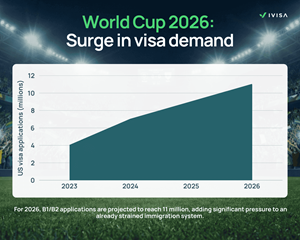
Surge in US visa demand
Legal Disclaimer:
EIN Presswire provides this news content "as is" without warranty of any kind. We do not accept any responsibility or liability for the accuracy, content, images, videos, licenses, completeness, legality, or reliability of the information contained in this article. If you have any complaints or copyright issues related to this article, kindly contact the author above.
