

The top news stories from the United States
Provided by AGP
actiTIME Marks 20 Years Bridging the Gap Between Simple Time Trackers and Enterprise Systems
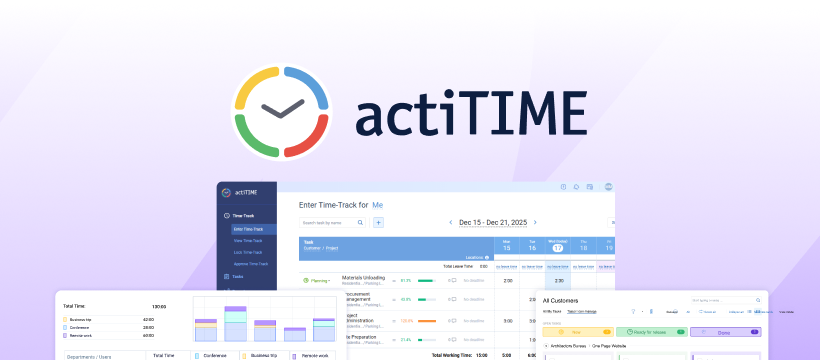
actiTIME marks 20 years building project time tracking software that connects hours to costs, billing, and profitability without enterprise complexity.
TORONTO, CANADA, May 14, 2026 /EINPresswire.com/ -- actiTIME, a project time tracking software provider, is marking 20 years in operation. The platform serves thousands teams in more than 130 countries and has received more than 1,000 five-star reviews.Project teams seeking visibility into costs, billing, and profitability have typically moved toward one of two categories of software: dedicated time tracking tools, which focus on recording hours, or enterprise systems that cover cost management alongside a broader set of financial and operational features. actiTIME developed its platform for teams that need financial reporting beyond basic hour logging but are not ready to adopt a full enterprise implementation.
The software covers time tracking, task and project management, cost reporting, and invoicing in one system. It tracks billable and non-billable hours, calculates the internal cost of work, monitors budgets at the task, project, and customer level, and produces a profit and loss report placing billed amounts next to the cost of delivery.
"Over the years, we have seen a shift in what teams are asking for," said Arina Katrycheva, CMO at actiTIME. "It used to be mostly about logging hours. Now teams want to know what their projects cost, what they are billing, and whether the work is actually profitable. Some go the enterprise route to get that visibility, which works but comes with real implementation overhead. We built actiTIME for teams that need that financial picture without that level of commitment."
The financial reporting layer includes a cost of work report that tracks payroll costs per user across regular hours, overtime, and leave time. The profit and loss report places those costs against billed amounts and generates a margin figure at the task, project, or client level. Budget monitoring covers three dimensions at once: time invested, cost incurred, and billing generated, each tracked against set limits throughout the project lifecycle.
Work types determine how hours are classified and what billing rate applies. Teams define their own billable and non-billable categories, and logging time against a work type applies the associated rate automatically. The result is that non-billable overhead — internal meetings, administrative work, scope conversations — is recorded in the same system as billable work, giving managers a complete view of where hours go across a project, not only what reaches the invoice.
For organizations with data governance requirements, actiTIME is available as a self-hosted installation with a one-time license, keeping all data on the organization's own infrastructure with no recurring subscription costs. The platform otherwise runs as a cloud subscription, with a flat unlimited-user license available for larger teams. A permanent free version supports teams of up to three users with no trial period or credit card required.
Arina Katrycheva
actiTIME
+1 877-571-5365
email us here
Visit us on social media:
LinkedIn
Instagram
Facebook
YouTube
actiTIME Project Time Tracking Software
Legal Disclaimer:
EIN Presswire provides this news content "as is" without warranty of any kind. We do not accept any responsibility or liability for the accuracy, content, images, videos, licenses, completeness, legality, or reliability of the information contained in this article. If you have any complaints or copyright issues related to this article, kindly contact the author above.
